











Now Reading: The 78-Year-Old Widower Who Mended a Town — One Stitch at a Time
-
01
The 78-Year-Old Widower Who Mended a Town — One Stitch at a Time

The 78-Year-Old Widower Who Mended a Town — One Stitch at a Time
When 78-year-old Walter lost his wife, Jenna, two years ago, the silence in their home was deafening.
“I didn’t know what to do with my hands,” he said. “They’d always been busy — fixing things, building things, holding hers. Now they just… hung.”
A Rainy Tuesday and a Basket of Thread
One rainy Tuesday, while sorting through Jenna’s things, Walter came across her old sewing basket — filled with buttons, tangled thread, and a bent needle.
He’d never sewn before. But there, on the floor, were her worn slippers. The seam on one was split. So he tried. His hands trembled. The stitches were crooked. But the seam held.
“It wasn’t pretty,” he admitted, “but it stayed together. And somehow, that felt like a small victory.”
A Stitch of Kindness
The next day, Walter noticed his neighbor, Mrs. Flora, drop coins from her torn coat pocket. Without thinking, he offered to fix it.
“She looked at me like I’d asked to borrow her purse,” he laughed. “But I stitched it right there on her porch. ‘For free,’ I told her. ‘Jenna would’ve done it.’”
That single act of kindness changed everything.
Soon, Walter began carrying a tiny repair kit in his jacket — needle, thread, a few safety pins. Wherever he went, he offered to fix small tears and broken pockets.
Students with ripped jeans. Nurses with torn scrub pockets. A man at the bus stop whose coat held his last bus pass.
“People everywhere had something broken,” Walter said. “And I realized… maybe I could help.”
Stitch Time
One afternoon, at the local library, Walter met a teenage girl crying over her backpack. A huge hole had opened in the side, and her books kept falling out.
“I fixed it while she watched,” he recalled. “She told me her grandma used to mend things, but she was gone now.”
Walter handed her a spool of thread and said, “Learn to fix it yourself. It’s not magic — just practice.”
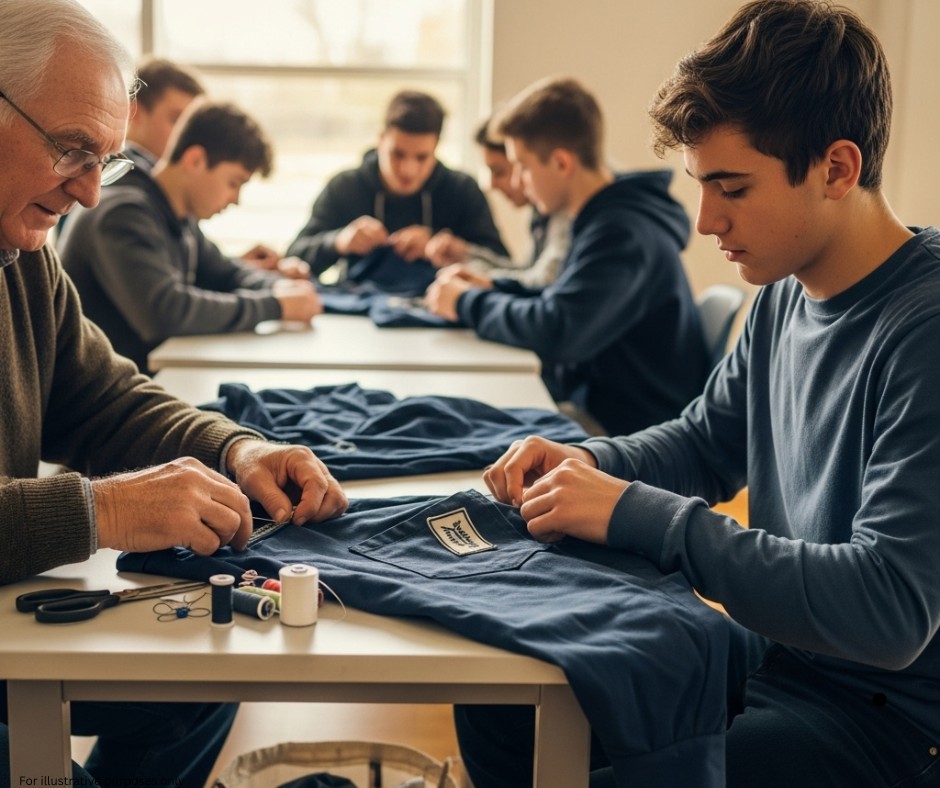
The girl returned the next week, bringing a friend. Then another. Soon, Walter was teaching a small group of teens how to sew at the community center. They called it “Stitch Time” — a simple table, some needles, and a whole lot of heart.
The Legacy of the Pocket Man
Months later, a boy named Leo came to Walter. His work uniform had a tear where his name tag belonged. “My boss said I’ll get fired if it’s not fixed by Monday,” he told him. Walter taught him to sew a strong square stitch. When Leo left, he hugged the old man. “You saved my job.”
A month later, Walter received a letter from Leo. He had started a “Pocket Club” at his high school — a small group mending clothes for families in shelters. They even repaired a veteran’s uniform for a job interview.
The letter ended with words that made Walter cry:
“You showed us that broken things can hold more than they did before.”
A Town Mended
Today, Walter’s hands are slower, his fingers arthritic. But every few days, he finds a bag of clothes hanging on his doorknob — torn jeans, old scrubs, worn dresses — with a note that says, “For the Pocket Man. We’ll mend what’s broken.”
“I cried,” Walter said. “Not from sadness, but from joy. Because I realized how one small stitch can weave strangers into family.”
He smiled, eyes soft with memory.
“You don’t need much to change the world,” he said. “Just a needle, some thread, and the courage to ask — Can I fix that for you?”