












Now Reading: 1843: Meet the Woman Who Invented the Future
-
01
1843: Meet the Woman Who Invented the Future

1843: Meet the Woman Who Invented the Future
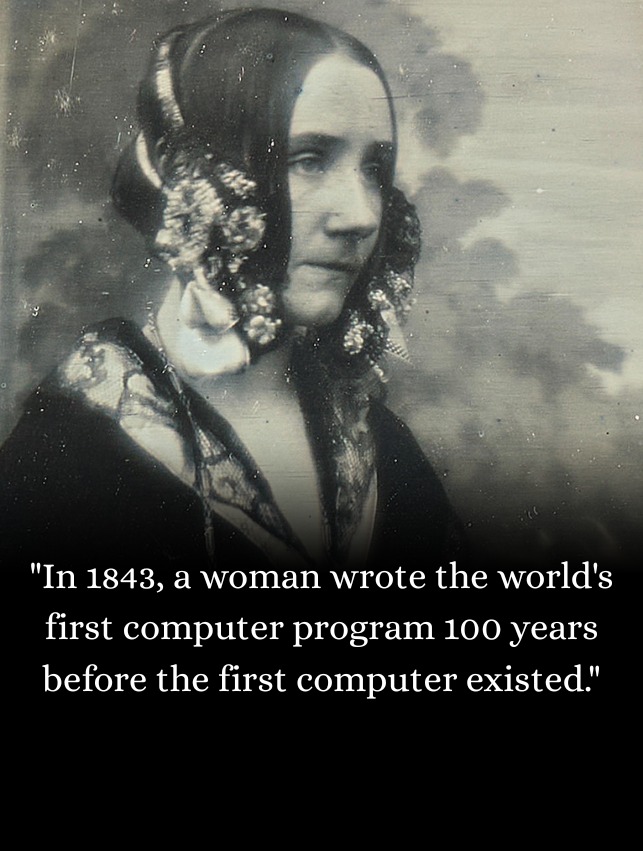
Imagine writing the world’s first computer program a full century before the first computer was built. This is the astonishing legacy of Ada Lovelace (1815–1852), a true visionary whose story should inspire anyone over 50 who understands that wisdom and imagination define the next chapter.
Born to the wildly imaginative poet Lord Byron and the rigorously logical mathematician Annabella Milbanke, Ada was a walking contradiction. Her mother tried to suppress her “dangerous” poetical nature with relentless logic, drilling her in subjects deemed unsuitable for women in 1820s England. But Ada combined her father’s vision with her mother’s discipline, creating “poetical science”—the ability to see art in algebra.
At 17, she met inventor Charles Babbage, who was building a mechanical calculator. While Babbage and his peers saw a fancy adding machine, Ada saw the future. In 1843, she wrote a detailed algorithm—the first computer program—for his device to calculate Bernoulli numbers. More profoundly, she predicted that this machine could be a universal processor, capable of generating music, language, and art. She described artificial intelligence in the age of horse-drawn carriages!
Her brilliance was dismissed as “too philosophical,” and she died young and forgotten. Yet, a century later, as engineers built the first electronic computers, they unearthed her notes and realized this Victorian woman had written the manual for their entire field.
Ada Lovelace proved that the greatest revolutions happen when imagination and logic collide. She never saw a computer, but she saw us—living in the digital age she dreamed into being. Her legacy is a powerful reminder that vision is the most important tool for innovation at any age.