













Now Reading: The Queen of the Waves: How Gertrude Ederle Redefined the Possible
-
01
The Queen of the Waves: How Gertrude Ederle Redefined the Possible

The Queen of the Waves: How Gertrude Ederle Redefined the Possible
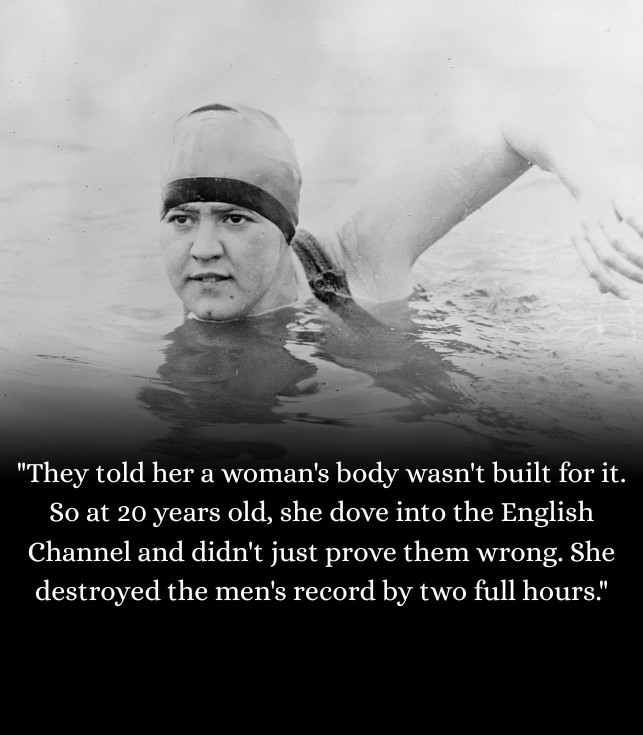
On August 6, 1926, a 20-year-old woman from Manhattan waded into the icy waters of the English Channel and emerged 14 hours later as a global icon. Gertrude Ederle didn’t just become the first woman to swim the treacherous 21-mile stretch; she shattered the existing men’s world record by more than two hours. In doing so, she dismantled centuries of prejudice regarding the physical capabilities of women.
A Life Shaped by the Water
Born in 1905 to German immigrants, Ederle’s relationship with the water was forged early. Despite contracting measles as a child—an illness that left her with permanent hearing damage—she refused to stay on land. By her teens, she was a phenomenon at the Women’s Swimming Association (WSA), where she mastered the “American crawl.” Before she turned 20, she held 29 national and world records and had secured three medals at the 1924 Paris Olympics.
Defying the Channel
The English Channel was considered the ultimate test of human endurance, characterized by six-foot waves, stinging jellyfish, and temperatures that induced hypothermia. After a failed first attempt in 1925—thwarted by a coach who didn’t believe a woman could finish—Ederle returned in 1926 on her own terms.
She innovated for survival, designing a revolutionary two-piece silk swimsuit and custom goggles to protect against the salt water. To combat the cold, she slathered her body in a thick layer of sheep’s grease and petroleum jelly.
The 35-Mile Triumph
Though the direct route was 21 miles, brutal storms and shifting tides forced Ederle to swim nearly 35 miles. When her coach urged her to quit during a squall, she famously pushed on, singing to herself to maintain her rhythm. When she finally touched British soil at Kingsdown, she had clocked a time of 14 hours and 31 minutes.
A Lasting Legacy
Ederle’s return to New York sparked a ticker-tape parade attended by an estimated two million people. Beyond the fame, her achievement was a political victory; the 1928 Olympics expanded women’s events largely because she had proven that “strength has no gender.”
Later in life, after surviving a spinal injury and total deafness, she dedicated herself to teaching swimming to deaf children. Gertrude Ederle didn’t just break a record; she proved that no current is too strong for a person who refuses to accept “impossible.”