













Now Reading: The Hammer that Uncovered a Fortune: The Story of the Hoxne Hoard
-
01
The Hammer that Uncovered a Fortune: The Story of the Hoxne Hoard

The Hammer that Uncovered a Fortune: The Story of the Hoxne Hoard
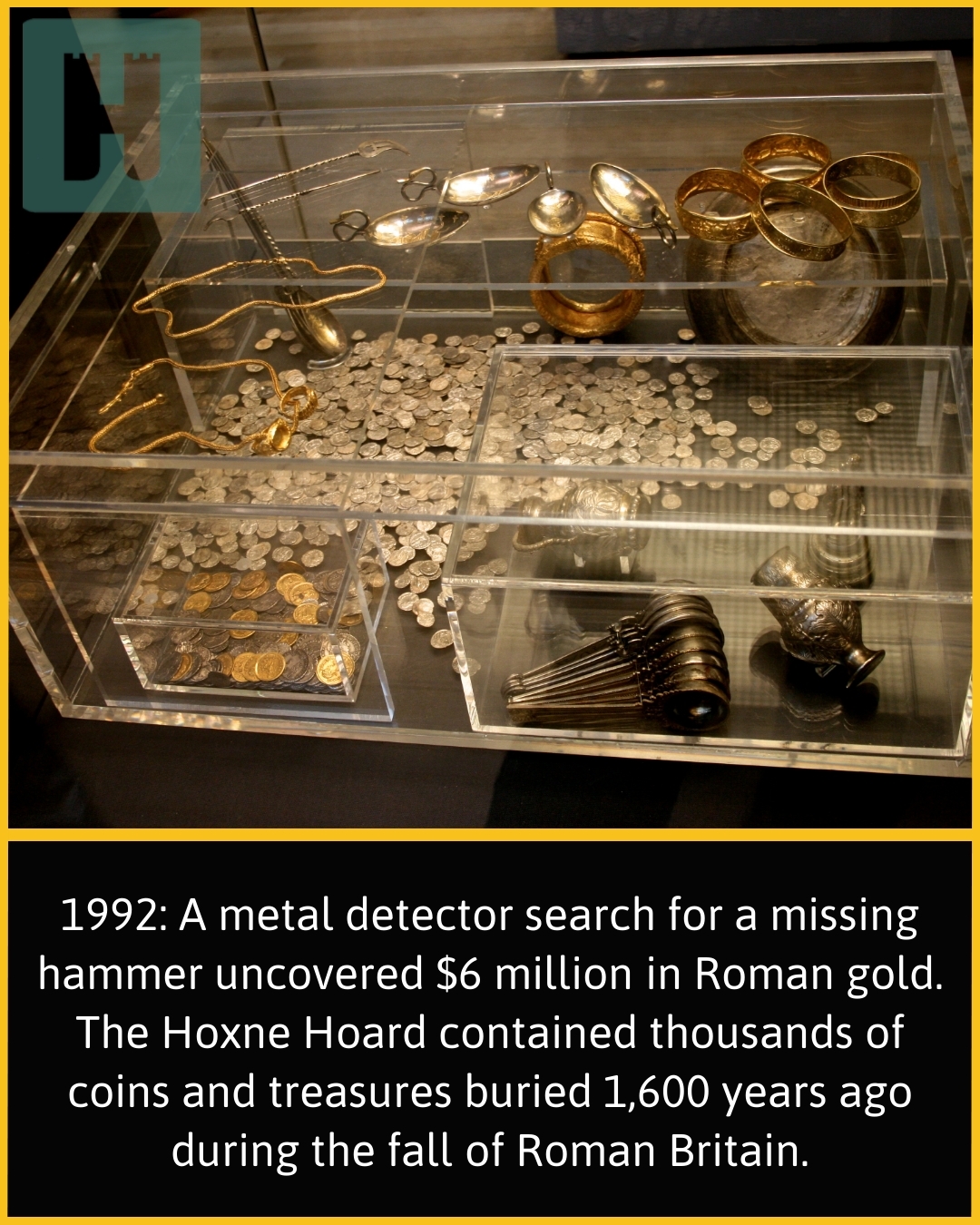
In 1992, Suffolk farmer Peter Whatling was simply looking for his lost hammer. He called his friend Eric Lawes, an amateur metal detectorist, to help scan the field. What they found instead was a signal so powerful it would rewrite the history of Roman Britain.
Beneath the soil of that ordinary English field lay the Hoxne Hoard, a staggering collection of over 15,000 Roman coins and 200 gold and silver artifacts. The find included exquisite jewelry, body chains, ladles, and silver “pepper pots”—one of which, shaped like a noblewoman, has since become an iconic symbol of the era.
The treasures date back to the early 5th century AD, a turbulent era when Roman authority in Britain was rapidly collapsing. Historians believe a wealthy Romano-British family, fearing the encroaching chaos of the empire’s withdrawal, packed their most precious belongings into a wooden chest and buried them for safekeeping. They likely intended to return once the danger passed; however, the chest remained untouched for over 1,500 years.
The craftsmanship of the hoard offers a rare glimpse into a society in transition. Intricate silver spoons inscribed with Christian symbols, alongside traditional Roman luxury items like the famous “silver tigress” handle, illustrate a unique fusion of old-world pagan wealth and emerging religious practices. The sheer volume of gold and silver proved that, even as the empire withdrew, Britain remained a place of immense prosperity.
True to the spirit of discovery, Whatling and Lawes reported their find immediately. Their integrity was rewarded with a $£$1.75 million prize, shared between them. Today, the hoard is a centerpiece of the British Museum. As for the hammer that started it all? It was eventually recovered and is now displayed alongside the gold—a humble reminder that sometimes, the greatest treasures are found when you are looking for something else entirely.