






Now Reading: Headlines and Hinges: The Engineering Marvel of Rockport’s Paper House
-
01
Headlines and Hinges: The Engineering Marvel of Rockport’s Paper House

Headlines and Hinges: The Engineering Marvel of Rockport’s Paper House
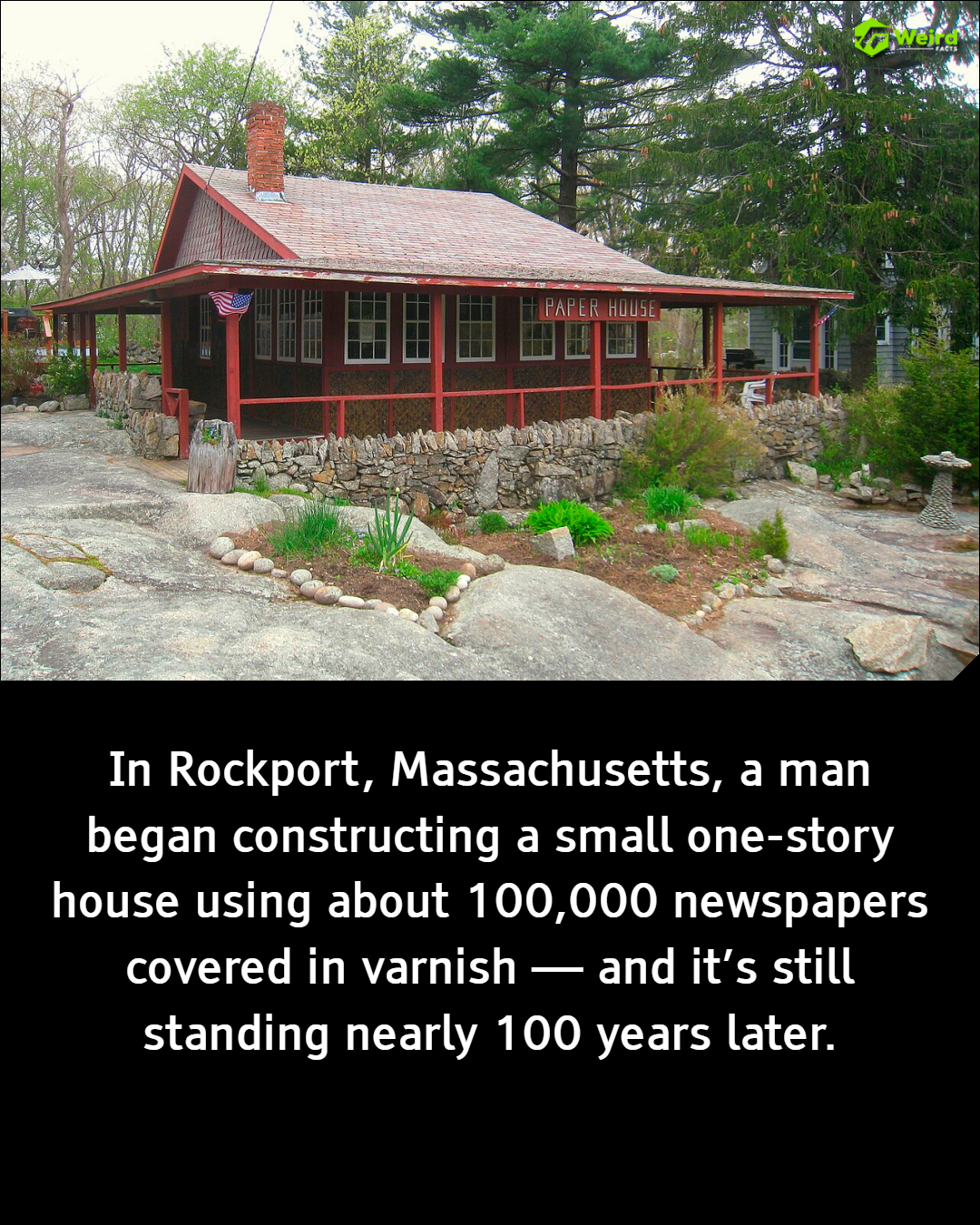
In the coastal town of Rockport, Massachusetts, stands a structure that redefines the concept of “yesterday’s news.” While most people discard their daily papers after a morning coffee, engineer Elis F. Stenman saw them as the blueprint for a home. In 1922, Stenman began a project that would eventually become the Paper House, a two-room summer cottage built almost entirely from newsprint.
From Stacks to Structures
The construction of the house was a feat of experimental engineering. Stenman didn’t just use paper for insulation; he used it as the primary building material. By stacking and pasting together more than 100,000 newspapers, he created walls and doors several inches thick. To ensure the house could withstand the New England elements, he sealed the entire exterior with a heavy coat of varnish, turning the fragile fiber into a durable, wood-like substance.
What began as an experiment in insulation evolved into a lifelong passion. Once the shell of the house was complete, Stenman didn’t stop. He turned his attention to the interior, meticulously rolling newspapers to construct:
-
Tables and chairs
-
A grandfather clock
-
Even a working piano (though the keys are not paper!)
A Living Museum of History
By 1927, the Paper House had transitioned from a private retreat to a full-fledged tourist attraction. Today, it remains under the care of the Stenman family, serving as a unique museum. Visitors can still walk through the rooms and, if they look closely at the furniture, read the headlines from nearly a century ago—including accounts of Charles Lindbergh’s flight and the political drama of the 1920s.
The Paper House stands as a testament to early 20th-century resourcefulness and the belief that even the most disposable items can, with enough patience and varnish, become permanent.