










Now Reading: I Stayed Silent at a Dinner with My Husband’s Japanese Client — Then I Understood Every Word They Didn’t Know I Could
-
01
I Stayed Silent at a Dinner with My Husband’s Japanese Client — Then I Understood Every Word They Didn’t Know I Could

I Stayed Silent at a Dinner with My Husband’s Japanese Client — Then I Understood Every Word They Didn’t Know I Could
For twelve years, I believed my marriage was steady. Not passionate, not dramatic, but dependable. We owned a neat townhouse in Mountain View, had two respectable careers, a shared digital calendar, and a life that looked successful from the outside. We were the kind of couple people assumed had it figured out.
My name is Sarah Chen. I work as a senior marketing coordinator at a mid-sized tech firm. I pay my share of the mortgage, handle the bills, remember birthdays, send thank-you notes, keep track of our parents’ medical appointments, and make sure there’s always coffee in the kitchen because David claims he “can’t survive mornings” without it. I’ve always been the dependable one—the person quietly keeping everything running so his life could appear effortless.
Somewhere along the way, I stopped being seen as a person and became more like background support.
When David earned his promotion to Director of Business Development last year, the balance shifted even more. He was constantly “in meetings,” endlessly “putting out fires,” always exhausted. Friday movie nights disappeared. Sunday hikes faded away. Dinner conversations became monologues about his stress and responsibilities. When I tried to talk about my own day—the campaign I’d landed, the presentation that went well, the coworker drama—he’d nod absently while scrolling through emails, his attention split as if I were just another notification on his phone.
So I carved out a small, hidden piece of life just for myself: I returned to studying Japanese.
Part One: The Secret Study
It started innocently—one free language app late at night. I’d taken Japanese in college years ago and loved it, then abandoned it like so many interests that didn’t fit into married life. The characters had fascinated me, the grammar puzzles had challenged me, and I’d dreamed of visiting Tokyo someday.
One app became nightly practice. Nightly practice turned into textbooks ordered discreetly from Amazon. Textbooks led to online tutors twice a week while David worked late. Soon I was watching Japanese dramas without subtitles, following podcasts, reading news articles.
While David complained about how “challenging” his Tokyo clients were and how “nobody here really understands the Japanese business culture,” I sat at the kitchen table memorizing kanji and training my ear to keep up with native-speed conversations.
I never told him. Not because it was secretive, but because I already knew how it would go. The last time I mentioned wanting to take a photography class, he’d laughed and said it was “cute” but impractical—I should focus on “real career development” instead. I’d learned not to offer him my enthusiasm just to watch it get dismissed.
So he continued believing I was the agreeable wife who didn’t really understand his important business world, and I let him believe it.
My tutor, Yuki, was a graduate student at Stanford. During our sessions, she’d sometimes ask about my marriage.
“Your husband doesn’t know you’re learning?” she asked one evening, her face pixelated on my laptop screen.
“No.”
“That’s unusual. Most students tell everyone. They’re proud.”
“I’m proud,” I said. “Just… privately.”
She studied me for a moment, then said something that stayed with me: “In Japan, we have a saying: neko wo kaburu. It means ‘to wear a cat’—to pretend to be harmless when you’re not.”
“I’m not pretending to be anything,” I protested.
“Aren’t you?”
I thought about that a lot in the following weeks. Was I pretending? Or was I just… surviving?
Part Two: The Invitation
Then one evening in October, David came home energized in that way he reserved for major successes. His tie was already loosened, his jacket over one arm, and he had that gleam in his eye that meant something big was happening.
“I’ve got great news,” he said, dropping his briefcase by the door. “We’re close to closing a deal with Sakura Technologies. Their CEO, Tanaka-san, is flying in next week. I’m taking him to dinner at Hashiri.”
He rattled off the details: an impossible reservation at San Francisco’s most exclusive Japanese restaurant, potential promotion to VP, the deal that could make his career.
“And you’ll come with me,” he added. It wasn’t a question.
“Me?”
“Yes. Tanaka values family. It looks good if I bring my wife.” He was already scrolling through his phone, barely looking at me. “Just dress conservatively, smile, and be pleasant. He doesn’t speak much English, so I’ll do all the talking. You’ll probably be bored, but it’s important for appearances.”
Important for appearances. That’s what I’d become.
“What should I wear?” I asked.
“Something professional. Navy dress, maybe? Nothing too flashy. Just look… supportive.”
Supportive. Not impressive. Not interesting. Just there, like a prop in the background of his success story.
“Okay,” I said. “I can do that.”
He smiled, kissed my forehead absently, and returned to his phone. Already moving on to the next email, the next fire, the next thing more important than the conversation we’d just had.
I went upstairs to our bedroom and opened my closet. Found the navy dress he’d mentioned—the one I’d worn to his company holiday party last year, where I’d spent three hours making small talk with spouses while the “real” employees discussed business.
Then I pulled out my phone and texted Yuki: Big test next week. Need to make sure my formal Japanese is perfect.
Her response came immediately: Let’s schedule extra sessions. I’ll help you prepare.
I smiled. For the first time in months, I felt something other than resignation.
I felt ready.
Part Three: The Dinner
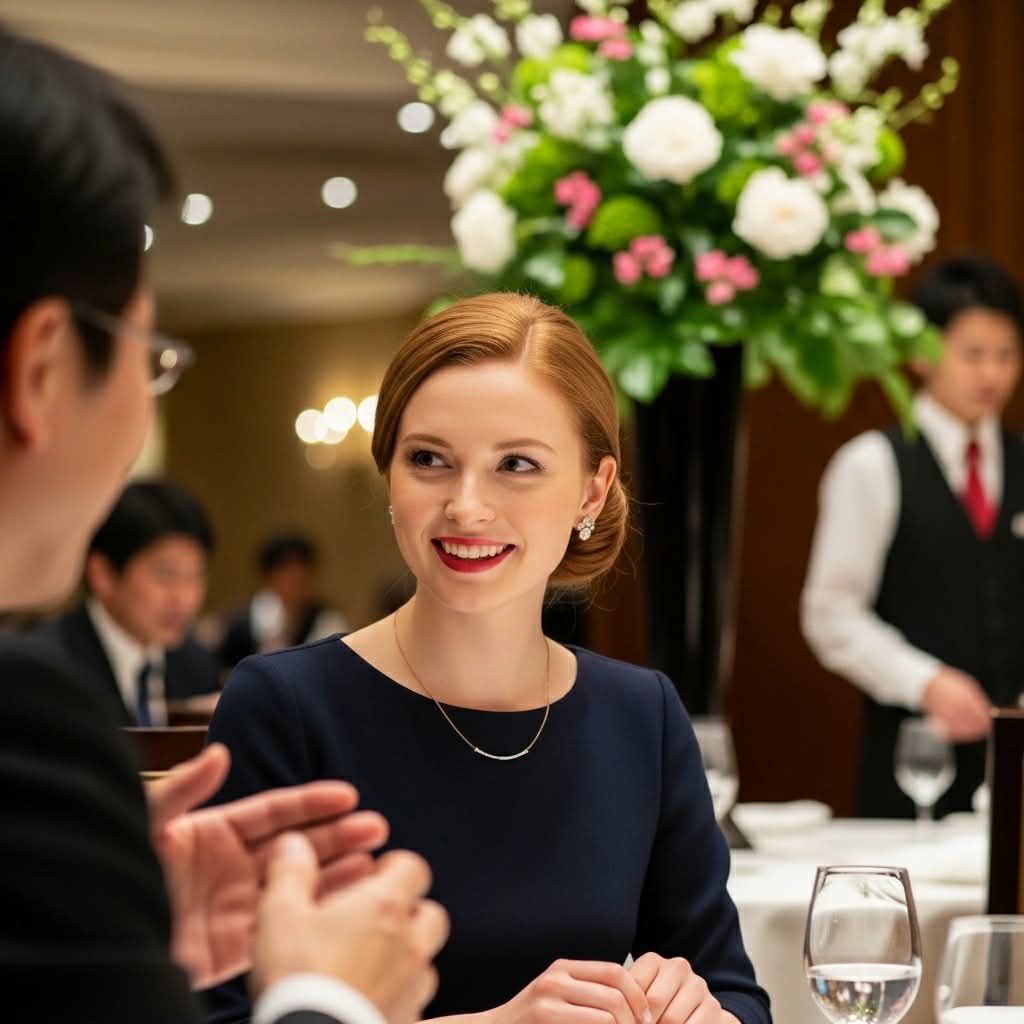
The restaurant was everything David had promised—elegant, exclusive, the kind of place where every detail whispered money and status. We were seated at a private table in a corner, shoji screens providing discrete privacy, a small arrangement of seasonal flowers as the centerpiece.
Tanaka-san arrived exactly on time, as expected. He was in his late fifties, silver hair perfectly groomed, wearing a suit that probably cost more than my car. His assistant, a younger man named Sato-san, accompanied him.
David stood immediately, bowing at precisely the right angle—he’d practiced, I realized. He’d actually practiced his bow.
“Tanaka-san, yokoso. Hajimemashite.” Welcome. Nice to meet you.
I stood as well, bowed politely, and said nothing. Playing my part.
Tanaka responded in Japanese, his accent formal and Tokyo-precise. David’s Japanese was… adequate. Not bad, but textbook—the kind you learn in business courses, functional but lacking nuance.
They settled into conversation. David explained the proposal, the timeline, the benefits of partnership. His Japanese was careful, occasionally hesitant, but mostly competent. Tanaka listened with the patient attention of someone accustomed to dealing with Americans who tried hard but missed subtleties.
I sat quietly, sipped my water, occasionally looked around the restaurant as if admiring the décor. The perfect disinterested wife.
The server brought the first course—delicate sashimi arranged like artwork. David fumbled slightly with his chopsticks. Tanaka pretended not to notice.
Then Tanaka turned to me and asked, in careful English: “Mrs. Reed, what do you do for work?”
Before I could answer, David cut in—switching to Japanese, his voice taking on that particular tone men use when explaining their wives to other men.
“Oh, Sarah?” He gave a small laugh. “She does some marketing work at a small firm. It’s mainly something to keep her busy during the day. She’s focused on taking care of the home. She doesn’t really understand what I do—it’s all quite technical.”
I kept my face neutral. Kept smiling. Tightened my grip on my water glass until I could feel the cold cutting into my palm.
Tanaka glanced at me, then back to David. “I see.”
That should have been the worst part—hearing my husband dismiss my career, my intelligence, my entire existence as just “something to keep her busy.”
It wasn’t.
David continued, comfortable now, believing he was in a safe space where I couldn’t understand. Still speaking Japanese: “Actually, I’ve been meaning to talk to you about the long-term structure of this partnership. I’ve been quietly moving assets—diversifying investments into accounts that aren’t jointly held. It gives me more flexibility for future business decisions without needing my wife’s approval for everything.”
My heart started beating faster. Not loud—just steady, cold, precise.
Tanaka’s expression didn’t change, but I saw Sato shift slightly, uncomfortable.
“Smart to keep business and personal separate,” David continued, reaching for his sake. “Especially because…” He paused, took a drink. “Well, I’ve been seeing someone else. Jennifer, from my office. We’ve been together for about six months now.”
The restaurant sounds—the quiet conversations, the gentle clink of porcelain, the soft traditional music—all seemed to fade to white noise.
“She understands me in ways my wife never could,” David said, almost confidentially, as if sharing a secret with a friend. “Sarah’s sweet, dependable, but not particularly ambitious. Jennifer gets it. Gets me. Gets what I’m building.”
He was telling a business associate—a man he’d met twice—about his affair. In Japanese. At a dinner I was sitting at. Because he believed I was too simple, too uninteresting, too beneath him to have learned his “difficult” language.
I didn’t react. Didn’t gasp. Didn’t throw my water in his face or storm out or cause any kind of scene. I just sat there, smile frozen, chopsticks steady, while my marriage dissolved in words I wasn’t supposed to understand.
Tanaka cleared his throat. Said something noncommittal about business being complex. Changed the subject back to timelines and deliverables.
David, oblivious, went along with it.
The dinner continued. More courses arrived. More sake was poured. David and Tanaka discussed technical specifications, market analysis, projected growth. I nodded occasionally when David glanced at me, as if to confirm I was still playing my role as the decorative, comprehending-nothing wife.
When dessert arrived—a delicate matcha panna cotta—Tanaka turned to me again. This time in Japanese.
“Reed-san no okusan, omochi no shigoto wa donna kanji desu ka?” Mrs. Reed, how do you find your work?
A direct question. In Japanese. To me.
David started to interject, but Tanaka raised a hand slightly—a gesture so subtle David almost missed it.
I could have answered. Could have responded fluently, letting David know in that moment that I’d understood every word, every confession, every betrayal.
Instead, I smiled apologetically and said in halting, textbook-careful Japanese: “Sumimasen, watashi no Nihongo wa heta desu.” Sorry, my Japanese is poor.
Tanaka’s eyes met mine for just a moment. Something passed between us—understanding, perhaps. Respect for playing the game well.
“Your English?” he asked gently.
“Much better,” I said, switching languages. “My work is fine. Nothing as exciting as what David does.”
“I see,” he said. And somehow, I knew he really did see.
The dinner ended with handshakes and bows. David was elated, practically bouncing as we left the restaurant.
“That went perfectly,” he said in the car. “Tanaka loved the proposal. This could mean VP by next quarter. Maybe even a relocation package to Tokyo.”
“Tokyo?” I asked quietly.
“Yeah, heading up the Asian operations. Can you imagine? You’d love it—all that shopping, the culture, being an expat wife.”
An expat wife. Not building my own career. Not pursuing my own interests. Just following him, supporting him, existing in the background of his increasingly important life.
“Sounds great,” I heard myself say.
He reached over and squeezed my hand. “Thanks for coming tonight. I know it was boring for you, but it really does help to have you there.”
I looked out the window at the San Francisco lights blurring past.
“No problem,” I said.
Part Four: The Call
We got home around eleven. David immediately went to his office to send follow-up emails, still riding his high, already planning his next moves.
I went upstairs to our bedroom, closed the door, sat on the edge of the bed, and pulled out my phone.
My hands were shaking. Not from fear—from pure, crystalline rage that I’d been holding back for three hours.
I scrolled through my contacts and found the name I’d never imagined I’d need: Emma Rothstein, my college roommate who’d gone to law school and become a divorce attorney.
We’d kept in touch sporadically over the years. She’d been at our wedding. She sent Christmas cards with photos of her kids. We exchanged occasional texts about getting together “sometime soon.”
I called her cell. It rang four times. I almost hung up.
“Sarah? Is that you? It’s almost midnight.”
“Emma,” I said, and my voice sounded strange even to me—flat, controlled, barely holding together. “I need a divorce lawyer.”
Silence on the other end. Then: “Are you safe? Where are you?”
“I’m home. I’m fine. I just… I need help.”
“Okay. Okay. Can you talk? Is he there?”
“He’s downstairs. In his office. He won’t come up for hours.”
“Tell me what happened.”
So I did. I told her about the dinner, about David’s Japanese confession, about the accounts I didn’t know about and the affair I wasn’t supposed to discover.
“Wait,” Emma interrupted. “He said all this in Japanese? And he doesn’t know you speak Japanese?”
“Yes.”
“Can you prove you understand it? If this goes to court, he’ll claim you misunderstood or—”
“I have a tutor. Yuki. Two years of lessons, documented payments, video sessions recorded in the cloud. I can pass any fluency test you want to give me.”
“Sarah Chen, you sneaky genius.” I could hear the smile in her voice, the lawyer in her already calculating. “Do you want to record him admitting the affair?”
“I don’t think California is a one-party consent state—”
“It’s not, but you can get him to put it in writing. Text messages, emails. Just start asking questions.”
“And the hidden accounts?”
“We’ll subpoena everything in discovery. If he’s been hiding assets, that’s financial fraud during marriage. It helps us significantly.”
We talked for another thirty minutes. She explained the process, the timeline, what I’d need to gather. Bank statements. Tax returns. Any evidence of his affair. Documentation of what I’d contributed to the marriage.
“How are you doing?” she asked finally. “Emotionally, I mean. This is a lot to process.”
“I’m angry,” I said honestly. “But also… relieved? Is that weird?”
“Not at all. Sometimes finding out the truth, even when it hurts, is better than living in the lie.”
After we hung up, I sat in the dark bedroom for a long time. Downstairs, I could hear David on a call, his voice energized, probably talking to Jennifer about how well the dinner went.
I pulled out my phone and opened a notes app. Started documenting everything I could remember from the dinner. Every word David had said in Japanese. Every detail about the accounts. Every mention of Jennifer.
Then I went to our shared laptop and started looking through files I’d never thought to question before. Found a folder labeled “Backup 2023” buried in his documents.
Inside were bank statements for accounts I’d never seen. Three of them. Totaling just over $340,000.
Money I’d never known existed.
I screenshot everything. Emailed it to myself from a new account he didn’t know about. Saved it to three different cloud services.
By the time David came to bed at 2 AM, I was pretending to sleep. He kissed my forehead like always, whispered “love you” like always, and fell asleep in minutes.
I lay awake until dawn, planning.
Part Five: The Gathering
Over the next two weeks, I became very, very interested in my marriage.
“Hey, babe?” I asked casually one morning over coffee. “I was thinking we should update our will. You know, with your promotion coming, we should make sure everything’s in order.”
He looked up from his phone. “Will? We did that years ago.”
“I know, but things change. Maybe we should review our accounts, make sure everything’s beneficiary-designated correctly.”
“I’ll handle it,” he said, already looking back at his screen. “Don’t worry about it.”
“I just want to make sure I understand everything. You know, in case something happens.”
He laughed. “Nothing’s going to happen. But sure, I’ll send you the info. Remind me later.”
He never sent it. But it was on record that I’d asked.
I started asking more questions. Casual ones. About his day. About Jennifer from his office.
“Oh, you mention her a lot,” I said over dinner one night. “Is she working on the Tanaka deal too?”
“Yeah, she’s been invaluable. Really sharp.”
“You should invite her over sometime. I’d love to meet the people you work with.”
His face did something complicated. “She’s pretty busy. Probably wouldn’t have time.”
“That’s too bad. She sounds nice.”
I could see him calculating, wondering if I suspected anything, deciding I was too oblivious to be a threat.
I also started documenting everything about my own contributions. Screenshots of bills I’d paid. Receipts for groceries I’d bought. Proof that I’d been paying exactly half the mortgage despite making less money—because David said it was “fair.”
I gathered tax returns. Found emails about investment decisions he’d made without consulting me. Downloaded twelve years of bank statements.
Emma had given me a checklist. I was working through it methodically, carefully, without David noticing anything had changed.
“You seem happier lately,” he commented one evening.
“Do I?”
“Yeah. Less stressed. It’s nice.”
I smiled. “I guess I’ve just been focusing on myself more. Doing things that make me happy.”
“That’s great, babe. You should do that more often.”
If only he knew what was making me happy.
Part Six: The Confirmation
Three weeks after the dinner, I went to lunch with Yuki. We met at a small café near Stanford, and for the first time, I told her everything.
“So you were wearing a cat that whole night,” she said when I finished. “And he never suspected.”
“No. He thinks I’m too simple to have learned Japanese without telling him.”
“What are you going to do?”
“File for divorce. But I need to know something first. My Japanese—it’s really good enough, right? If this goes to court, if I have to prove I understood him correctly?”
She pulled out her phone. Opened a voice recording app.
“Tell me, in Japanese, exactly what he said. Everything you remember. I’ll transcribe it, translate it, and have it notarized by the translation service my department uses.”
So I did. In fluent, precise Japanese, I recounted the entire conversation. Every word about the hidden accounts. Every word about Jennifer. Every dismissive comment about me.
Yuki’s face grew serious as she listened. When I finished, she said, “Sarah, your Japanese is excellent. Better than excellent. You could pass the N2 exam easily, maybe N1.”
“So if I had to testify—”
“You could testify in Japanese if needed. But with this recording, transcribed and translated by a certified translator? This is ironclad evidence.”
We spent the next hour going over details. She promised to have the translation ready in three days, professionally notarized.
“Can I ask you something?” she said as we were leaving. “Why did you learn? Really?”
I thought about it. “At first, it was just something for me. A hobby. An escape. But then…” I paused. “Then it became a way to see the truth. To understand who he really was when he thought nobody was watching.”
“And what did you see?”
“A man who never saw me at all.”
Part Seven: The Filing
I filed for divorce on a Tuesday morning. Emma handled everything, filing at the courthouse while I was supposedly at work.
David’s reaction was exactly what I expected.
He came home that evening with the papers, his face a mixture of shock and anger I’d never seen before.
“What the hell is this?” He threw the documents on the kitchen counter. “Divorce? Are you serious?”
“Completely serious.”
“Why? What happened? I thought we were fine!”
“You thought we were fine because you never actually looked at me long enough to see that we weren’t.”
“That’s not—this is crazy. Is this about me working too much? I told you, once this promotion goes through—”
“It’s not about you working too much.”
“Then what? Just tell me what’s wrong and we’ll fix it!”
“It’s not fixable, David.”
He ran his hands through his hair, pacing. “Is there someone else? Is that what this is?”
The irony almost made me laugh. “No. There’s no one else.”
“Then I don’t understand. We’re good together. We have a good life. Why would you throw that away?”
“Because you already threw it away. I’m just making it official.”
“That doesn’t mean anything! You’re not making sense!”
I pulled out my phone. Opened the recording from Yuki’s translation service. Hit play.
His voice filled the kitchen, speaking Japanese: “She does some marketing work at a small firm. It’s mainly something to keep her busy during the day…”
His face went white.
I let it play. All of it. The hidden accounts. The affair. Every dismissive word about me.
When it ended, the silence was absolute.
“You…” His voice was barely a whisper. “You understood. The whole time.”
“Every word.”
“How long have you spoken Japanese?”
“Two years. While you were working late. While you were with Jennifer. While you were transferring our money into accounts I wasn’t supposed to know about.”
He collapsed into a chair. “Sarah, I can explain—”
“Don’t. I’ve heard enough explanations in Japanese. I don’t need any in English.”
“The accounts—that money is for our future—”
“Our future? You were planning to leave me. You said it yourself. You’re just upset that I’m leaving first.”
“Jennifer doesn’t mean anything. It was just—”
“I don’t care what it was. I care that you told a business contact about it before you ever told me. I care that you dismissed my career, my intelligence, my entire existence like I was just… furniture.”
“I didn’t mean it like that—”
“Yes, you did. You meant every word. You just thought you could say it safely because you assumed I was too stupid to learn your ‘difficult’ language.”
He stared at me, and I saw the moment he realized he’d lost. Not just the marriage—everything. The moral high ground. The narrative. The ability to paint me as the unreasonable one.
“What do you want?” he finally asked.
“I want half of everything. Including the accounts you thought you’d hidden. I want this house sold and the equity split. And I want you to sign the papers without making this harder than it needs to be.”
“And if I don’t?”
I held up my phone. “Then this recording gets played in court. Along with testimony from my Japanese tutor, certified translations, and documentation of every lie you’ve told. Your business reputation survives if we keep this quiet and simple. It doesn’t survive if the Tanaka deal falls apart because he finds out you were badmouthing your wife in Japanese at a business dinner.”
His face went from white to red. “You wouldn’t.”
“Try me.”
We stared at each other across the kitchen counter. This man I’d spent twelve years with, who I’d loved, who I’d believed loved me back.
“I never knew you could be this cold,” he said.
“I learned from the best,” I replied.
Part Eight: The Settlement
The divorce took four months. David tried to fight it at first, but Emma had built an airtight case. The hidden accounts were financial fraud. The affair was grounds for fault-based divorce in California under “irreconcilable differences” with clear blame.
More importantly, the recording killed his credibility. Once his lawyers heard it, they advised him to settle.
We split everything 50/50. The house, the investments, even the hidden accounts. David had to cash out investments early, taking tax hits he’d tried to avoid.
Jennifer called me once, two months into the process.
“I didn’t know he was still married,” she said. “He told me you were separated.”
“We weren’t.”
“I’m sorry. I should have… I should have checked.”
“Yes, you should have.”
“For what it’s worth, I ended it. When I found out he’d lied to both of us.”
“That’s something, I guess.”
There was a long pause. “He’s not a good person, is he?”
“No,” I said. “He’s not.”
She hung up. I never heard from her again.
The Tanaka deal fell through. I don’t know exactly what happened, but Emma heard through her network that Tanaka pulled out after learning about David’s divorce. Something about “family values” and “trust in business partnerships.”
David’s promotion disappeared with it.
I can’t say I was sorry.
Epilogue: One Year Later
I’m sitting in a café in Tokyo. Jetlag is making the afternoon feel surreal, but I don’t care. I’m here. Actually here.
After the divorce settled, I used my half of the house sale to pay off all my debts and booked a month-long trip to Japan. Not as an expat wife. As myself.
I’m staying in a small apartment in Shibuya, taking intensive language classes during the day, exploring the city at night. I’m finally good enough to chat with shopkeepers, order food confidently, make friends at my school.
My teacher, Kimura-sensei, asked me yesterday why I learned Japanese.
“For myself,” I said. “Because I wanted to.”
“Not for work? For travel?”
“For me,” I repeated. “Just for me.”
She smiled. “That’s the best reason.”
Last week, I had coffee with Tanaka-san. He’s in Tokyo for the month too, and when I emailed him—in Japanese—asking if we could meet, he agreed immediately.
We talked about the dinner, about David, about everything that had happened.
“I knew,” he said quietly. “That night, when you pretended not to understand. I knew you were fluent.”
“How?”
“Your face. The way you held very still when he talked about the other woman. Native speakers can always tell when someone understands but pretends not to.”
“Why didn’t you say anything?”
“It wasn’t my place. But I respected you for playing the game strategically. In Japanese business culture, we understand sometimes you must wear the cat to survive.”
He’d pulled his business from David not because of the divorce, he explained, but because of the disrespect. “A man who speaks carelessly about his wife in front of strangers cannot be trusted in business. That is what I told my board.”
Before he left, he handed me his card. “If you ever want to work in Japan—real work, using your skills—contact me. I have partnerships with marketing firms here who need people who understand both cultures.”
I kept that card. Put it in my wallet next to my passport and the photo of myself on the day my divorce was finalized.
In that photo, I’m smiling. Really smiling. Not the polite smile I wore for twelve years. The genuine one I’d forgotten I had.
Tonight, I’m meeting my language school friends for karaoke. Tomorrow, I’m taking a calligraphy class. Next week, I’m visiting Kyoto.
And in a month, when I go back to California, I’ll be returning to my own apartment, my own job that I’m actually good at, my own life that I’m building exactly the way I want.
David texted me once, three months after the divorce finalized. Just three words: I miss you.
I never responded.
Because the truth is, he never actually knew me well enough to miss. He missed the idea of me—the supportive wife, the background decoration, the woman who kept his life running smoothly while demanding nothing for herself.
That woman doesn’t exist anymore.
I killed her the night I sat in that restaurant and smiled while my marriage burned down in a language he thought was safe.
And I’ve never been more alive.