












Now Reading: Solving the Viral Math Challenge: The Power of Order of Operations
1
-
01
Solving the Viral Math Challenge: The Power of Order of Operations

Solving the Viral Math Challenge: The Power of Order of Operations
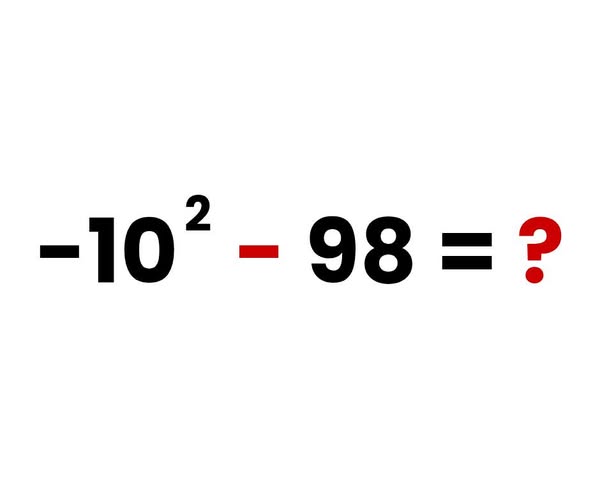
This mathematical expression highlights a common point of confusion regarding the order of operations, specifically the distinction between a negative sign and a negation within an exponent. According to the standard rules of arithmetic (PEMDAS/BODMAS), the exponentiation must be performed before the subtraction; therefore, $10^2$ is calculated first to equal $100$, and only then is the negative sign applied to result in $-100$. When you subtract $98$ from $-100$, the final result is -198. This serves as an excellent reminder that without parentheses to group the negative sign with the base, the exponent only applies to the number itself, a nuance that often separates a quick guess from a mathematically sound solution.