













Now Reading: The Living Room’s Human Interface: Life Before the “Clicker”
-
01
The Living Room’s Human Interface: Life Before the “Clicker”

The Living Room’s Human Interface: Life Before the “Clicker”
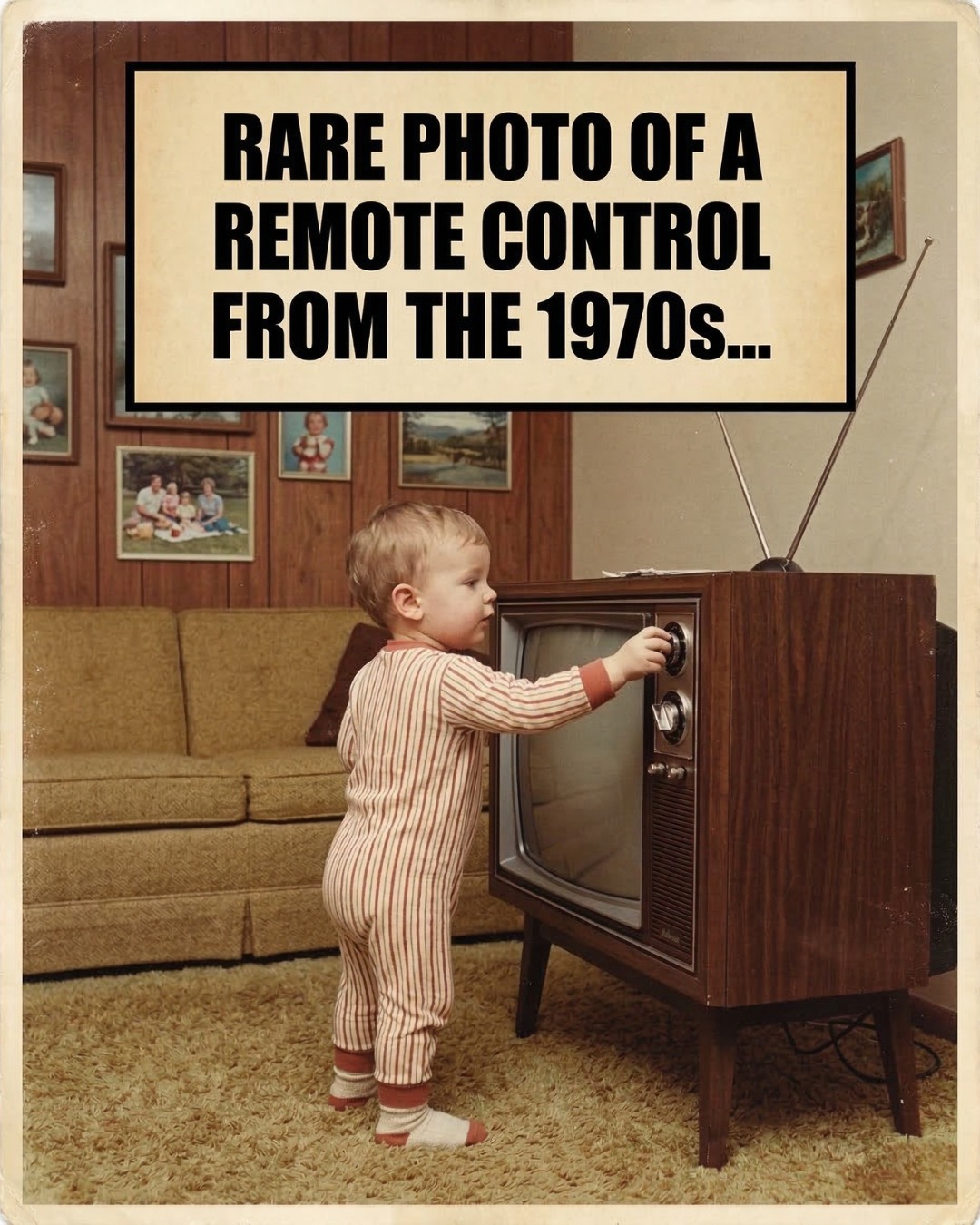
The image above captures a quintessential moment of 20th-century domestic life, albeit with a wink and a nod to those who lived through it. To the uninitiated, it looks like a toddler playing with a vintage television. To a Boomer or Gen Xer, it’s a photograph of the most reliable remote control ever invented: the youngest child in the house.
The Original Voice Command
Before the era of infrared sensors and Bluetooth connectivity, changing the channel was a physical endeavor. In the 1970s, “remote control” didn’t refer to a plastic wand lost in the sofa cushions; it was a verbal command issued from the comfort of a recliner. “Junior, go turn it to channel four,” was the Siri of its day.
The technology was surprisingly sophisticated for its time:
-
Haptic Feedback: That satisfying, heavy clunk-clunk-clunk of the rotary dial as you cycled through the three available channels.
-
Signal Optimization: The “remote” was often tasked with adjusting the “rabbit ear” antennas, standing on one leg while holding a piece of tin foil to stop the picture from flickering.
-
Zero Battery Requirements: Powered entirely by the promise of staying up five minutes past bedtime.
A Lost Aesthetic
Beyond the joke, the photo serves as a museum of mid-century interior design. From the wood-paneled walls to the avocado-green shag carpeting, the environment was as much a part of the viewing experience as the show itself. Televisions weren’t sleek, ultra-thin panels mounted to the wall; they were substantial pieces of furniture—heavy, wooden consoles that occupied a place of honor in the living room.
While we now enjoy the convenience of scrolling through thousands of titles without moving a muscle, there is a certain nostalgia for the tactile, shared effort of the 70s living room. It was a time when changing the channel required a conversation, a bit of physical exercise, and—occasionally—a very helpful toddler.