












Now Reading: The 1883 Solar Mystery: José Bonilla’s Unexplained Observation
-
01
The 1883 Solar Mystery: José Bonilla’s Unexplained Observation

The 1883 Solar Mystery: José Bonilla’s Unexplained Observation
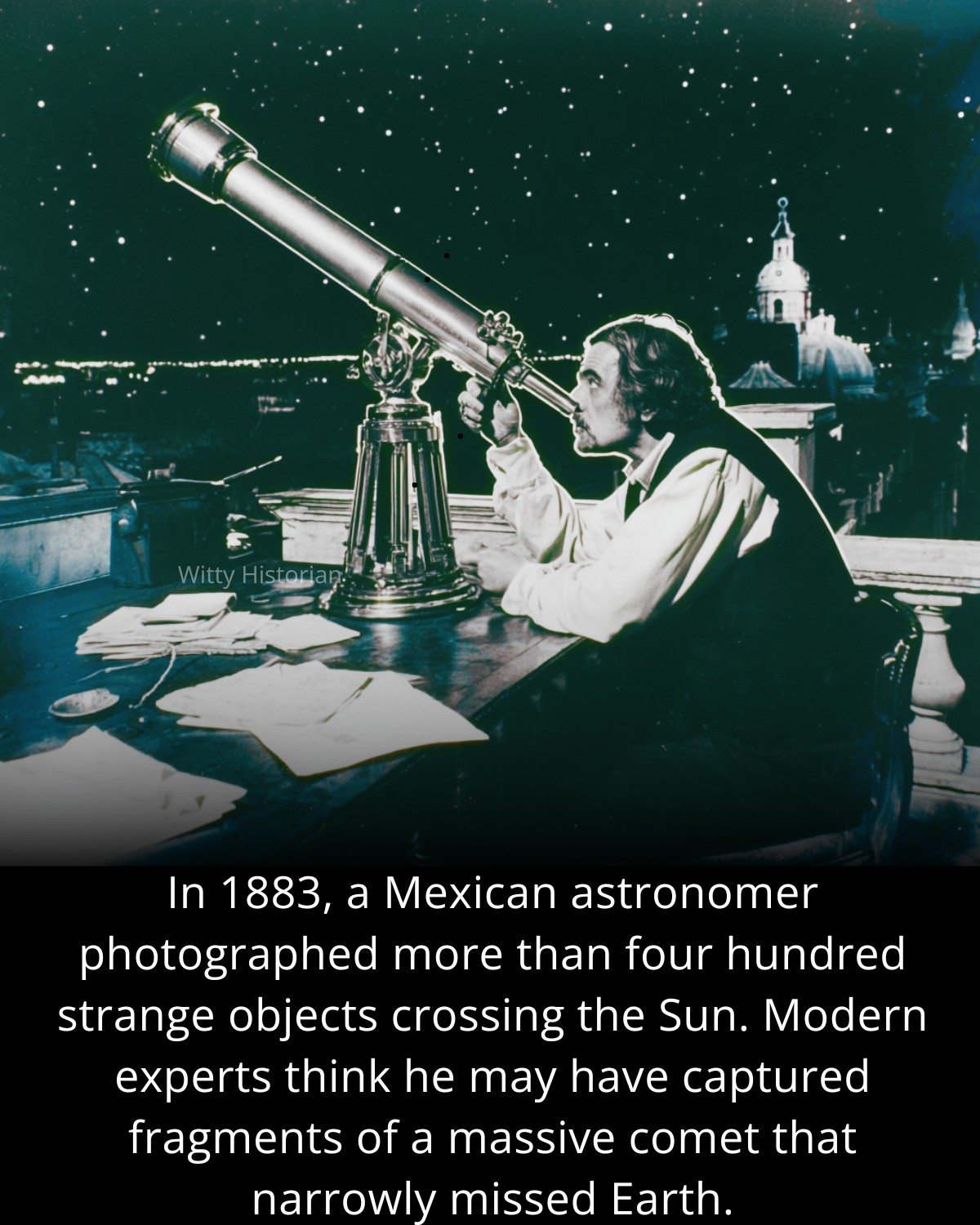
An extraordinary and baffling event unfolded in 1883 when Mexican astronomer José Bonilla was observing the Sun from his observatory in Zacatecas. Bonilla recorded a phenomenon that defied explanation, capturing what has become one of the most enigmatic astronomical events of the 19th century.
🌑 The Observation: Dark Shapes Crossing the Sun
Over a period of two days, Bonilla observed and photographed a steady stream of dark, unexplained shapes passing directly in front of the Sun’s disk. Each object left a faint outline on his photographic plates.
In total, Bonilla meticulously counted more than four hundred of these objects, noting that they crossed the solar surface in tightly grouped clusters. Unable to identify the objects, Bonilla remained cautious, simply recording the event as he saw it and presenting his data without drawing firm conclusions.
🔬 Nineteenth-Century Debate
Bonilla’s unusual findings quickly made their way into the press, sparking a lively debate among scientists of the era. The consistency, size, and sheer number of the objects immediately ruled out common explanations such as:
-
Birds
-
Insects
-
Dust clouds
-
Atmospheric shadows
The nature of the objects remained a genuine mystery that contemporary science could not resolve.
☄️ A Modern Theory: Cosmic Near Miss
More than a century later, modern astronomical experts have proposed a compelling and dramatic explanation for Bonilla’s unique photographs.
The prevailing theory suggests that Bonilla may have captured the fragments of a massive comet that had disintegrated as it passed close to Earth. These numerous pieces could have streaked through space, crossing the path between Earth and the Sun at the perfect moment—close enough to be observable and photographed, yet far enough away to avoid causing a catastrophic impact.
If this theory is correct, José Bonilla’s 1883 observation inadvertently documented what was potentially one of the closest cosmic near misses in recorded human history.
🌌 Modern Astronomy’s Biggest Unsolved Mysteries
Many of the most significant unsolved problems in astronomy and cosmology today concern the fundamental composition and behavior of the universe at its largest scales. These are problems that challenge our current models of physics, including Einstein’s theory of General Relativity.
🌑 Dark Matter and Dark Energy
The biggest mysteries revolve around what the universe is actually made of. Scientists have determined that ordinary baryonic matter (the stuff that makes up stars, planets, and us) accounts for only about 5% of the total mass-energy density of the universe. The rest is comprised of two elusive, invisible components:
-
Dark Matter (approx. 26%): This is an invisible substance that does not emit, absorb, or reflect light, making it impossible to detect directly. Its presence is inferred solely through its gravitational pull. Without it, galaxies would rotate so fast their stars would fly apart. We do not know what particle or field constitutes dark matter. The “missing satellites” and “core-cusp” problems highlight the current disagreement between simulations of dark matter (like the $\Lambda$CDM model) and actual galactic observations.
-
Dark Energy (approx. 69%): This is the even greater mystery. Dark energy is the force responsible for the accelerating expansion of the universe. It acts like a repulsive form of gravity, pushing space itself apart. The nature, origin, and density of dark energy are completely unknown, and understanding it is one of the greatest challenges in modern physics.
⚛️ The Matter-Antimatter Asymmetry
Another profound puzzle is the Baryon Asymmetry or the matter-antimatter problem.
-
According to the Big Bang theory and the laws of physics, the early universe should have created equal amounts of matter and antimatter.
-
When a particle of matter meets a particle of antimatter, they should annihilate each other, converting all their mass into energy (photons).
-
If this perfect balance had occurred, the universe would today be filled with only radiation and no matter—meaning no stars, no planets, and no life.
-
The fact that the visible universe is composed almost entirely of matter means there must have been a slight excess of matter created in the early moments of the Big Bang, a phenomenon known as baryogenesis. The underlying physics that explains this critical imbalance is still unknown.
🔭 The Hubble Tension
The Hubble Tension is a modern crisis in cosmology. It refers to the significant disagreement between two primary methods used to calculate the Hubble Constant ($H_0$), the value representing the current rate of the universe’s expansion:
-
Early Universe Measurements: Calculating $H_0$ based on observations of the Cosmic Microwave Background (CMB)—the “afterglow” of the Big Bang—gives one value.
-
Late Universe Measurements: Calculating $H_0$ based on observations of local, bright objects like supernovae (using the cosmic distance ladder) gives a consistently higher value.
This discrepancy, which is too large to be explained by measurement error, suggests that either there is a systematic flaw in our measurements or, more dramatically, that our current Standard Model of Cosmology ($\Lambda$CDM) is incomplete or incorrect.