







Now Reading: The Ghost of Dutchman’s Curve: Remembering the Great Train Wreck of 1918
-
01
The Ghost of Dutchman’s Curve: Remembering the Great Train Wreck of 1918

The Ghost of Dutchman’s Curve: Remembering the Great Train Wreck of 1918
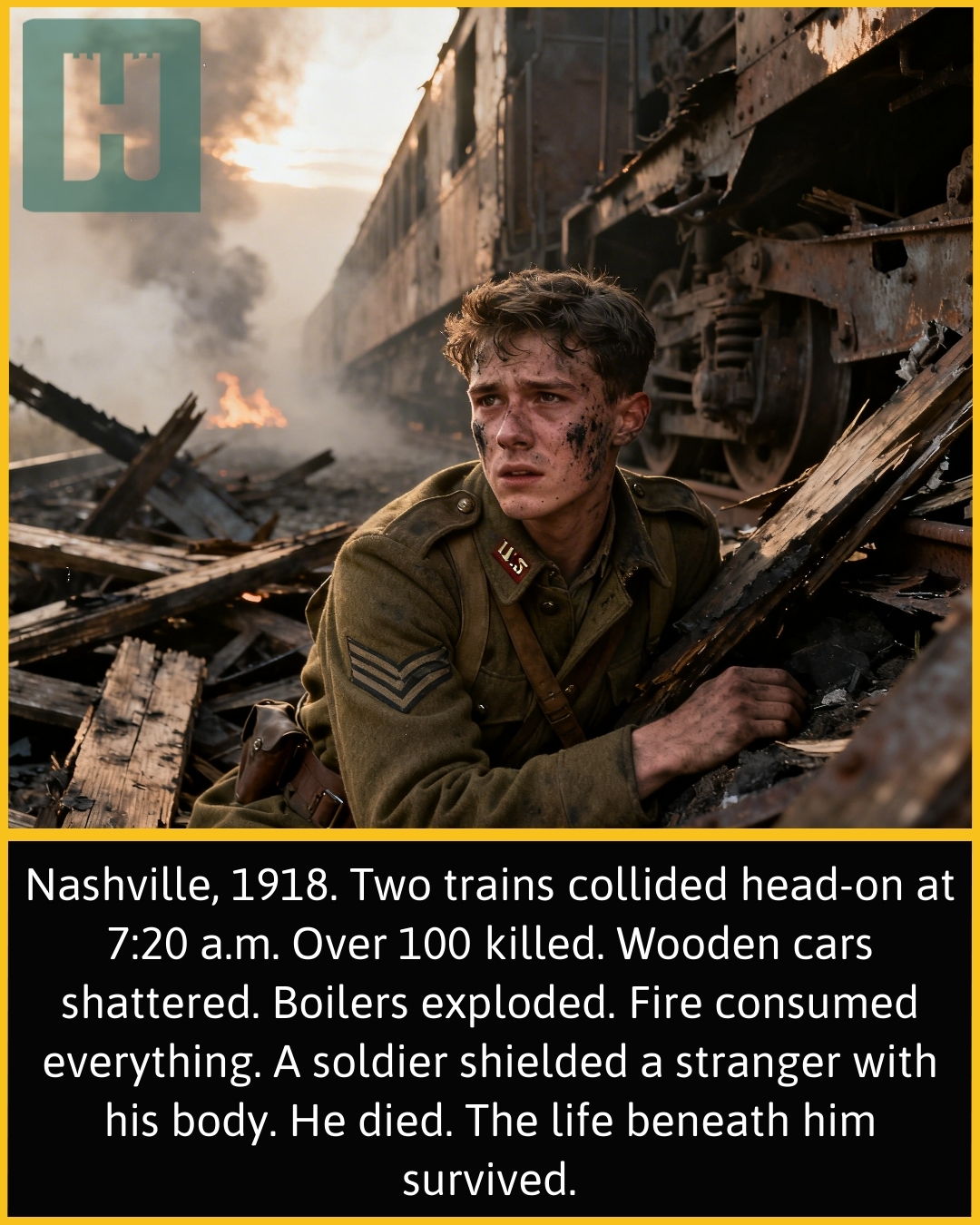
It remains the deadliest rail accident in United States history, a catastrophe born of a single dispatcher’s oversight and a series of systemic failures. On a humid July morning in 1918, the “Great Train Wreck” claimed 101 lives, leaving a scar on the American railroad system that eventually forced a total revolution in transit safety.
A Collision Course of Human Error
The disaster was set in motion by a scheduling conflict on a single-track line. A dispatcher in Nashville failed to properly coordinate two packed passenger trains: an inbound local arriving from Memphis and an outbound express. Both were filled to capacity with laborers, families, and soldiers heading toward the front lines of World War I.
The two locomotives met head-on at a section of track known as Dutchman’s Curve. The impact was heard miles away. At the time, passenger cars were primarily constructed of wood; upon collision, they splintered like matchsticks. The tragedy was compounded when the steam boilers ruptured, unleashing scalding water and igniting fires that swept through the wooden debris, trapping survivors in an unimaginable inferno.
The Anonymous Sacrifice
Among the harrowing accounts of the wreckage, one story of individual heroism emerged from the smoke. Rescuers discovered the body of an unidentified soldier pinned beneath twisted metal. He had used his own body as a shield, bracing himself against the collapsing roof of the car to protect a young girl.
When the debris was finally cleared, the soldier was dead, but the child was pulled from his arms nearly unharmed. Despite his ultimate sacrifice, the soldier’s name was never confirmed. He remains a silent symbol of the disaster—a stranger who, in his final seconds, decided that a child’s life was worth more than his own.
“His heroism didn’t need a name to leave a legacy,” noted a local historian. “It was a single human moment of grace in a disaster caused by institutional neglect.”
A Catalyst for Change
The horror of Dutchman’s Curve became the turning point for the American rail industry. The “wooden era” of travel came to an abrupt end as the disaster proved that such cars were essentially kindling in an accident.
Key Safety Reforms Following the Wreck:
-
Material Shift: The industry accelerated the phasing out of wooden passenger cars in favor of reinforced steel construction.
-
Signaling Technology: Implementation of advanced automatic block signaling to prevent two trains from entering the same section of track.
-
Strict Protocols: New, redundant scheduling and communication mandates for dispatchers to eliminate “single-point-of-failure” human errors.
While these reforms saved countless lives in the century that followed, they arrived too late for the 101 souls lost in Nashville. Today, the wreck stands as a somber reminder of the high cost of progress and the anonymous heroes who emerge when systems fail.