













Now Reading: The Great Divide: The Hidden Hydrological Wonder of Two Ocean Pass
-
01
The Great Divide: The Hidden Hydrological Wonder of Two Ocean Pass

The Great Divide: The Hidden Hydrological Wonder of Two Ocean Pass
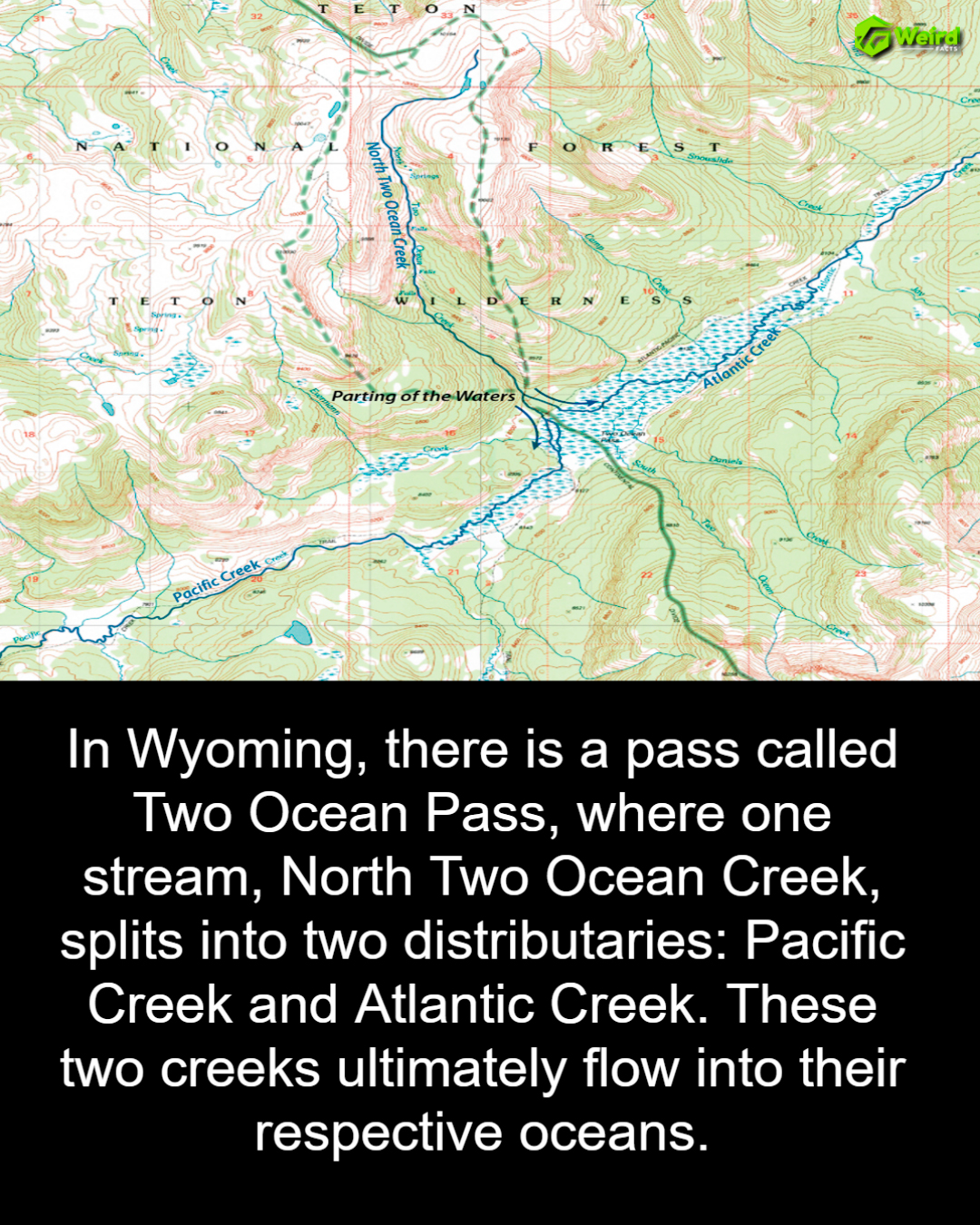
Deep within the rugged expanse of Wyoming’s Teton Wilderness lies a geographical anomaly so rare it almost defies the laws of nature. At an elevation of over 8,000 feet, a single stream does the impossible: it splits in two, sending its waters on a journey toward two different oceans on opposite sides of the continent. Known as Two Ocean Pass, this site is home to the legendary Parting of the Waters, a National Natural Landmark that serves as a living map of North America’s watershed.
A Natural Fork in the Road
The phenomenon begins with North Two Ocean Creek. As the creek descends from the mountains, it reaches a nearly level meadow on the Continental Divide. Because the terrain is so flat, the water loses its singular direction and naturally bifurcates—or splits—into two distinct channels. This isn’t a man-made irrigation feat; it is a natural, permanent division of a single source of water.
A Tale of Two Journeys
Once the water reaches the Parting of the Waters, it embarks on two vastly different adventures:
-
The Pacific Route: The western fork becomes Pacific Creek. It rushes toward the Snake River, joins the mighty Columbia River, and eventually empties into the Pacific Ocean. This journey covers approximately 1,353 miles.
-
The Atlantic Route: The eastern fork becomes Atlantic Creek. Its path is significantly more grueling, winding through the Yellowstone, Missouri, and Mississippi Rivers before finally reaching the Gulf of Mexico. This trek spans a staggering 3,488 miles.
A Historic Discovery
Though indigenous peoples were likely aware of this “meeting of the waters” for centuries, the first recorded account by Western explorers dates back to the 1830s. Early trappers and mountain men told stories of a place where a trout could swim from the Pacific to the Atlantic without ever leaving the water. While that might sound like a tall tale, the hydrological connection is real. In 1965, the site was officially designated a National Natural Landmark, cementing its status as one of the most significant geological features in the United States.
The Heart of the Continent
Two Ocean Pass is more than just a curiosity for hikers and geologists; it is a profound reminder of how interconnected our planet’s ecosystems are. At this tiny point in the Wyoming wilderness, the fate of a single drop of rain is decided by a few inches of silt and gravel. Whether that drop ends up in the cold depths of the Pacific or the warm currents of the Gulf depends entirely on which side of the “Parting” it falls.