












Now Reading: The Mountain in the Sky: Scaling Comet 67P
-
01
The Mountain in the Sky: Scaling Comet 67P

The Mountain in the Sky: Scaling Comet 67P
In the vastness of the cosmos, we often perceive comets as mere “shooting stars”—fleeting, weightless streaks of light. However, the reality of Comet 67P/Churyumov–Gerasimenko is far more terrestrial and imposing. When the European Space Agency’s Rosetta mission reached 67P in 2014, it revealed a celestial body that wasn’t just a rock, but a massive, jagged world of ice and dust with a scale that defies simple description.
To truly understand 67P, one must stop looking at the stars and start looking at the skyline.
The “Rubber Duck” Geography
Comet 67P is famously “bi-lobed,” meaning it consists of two distinct sections connected by a narrow neck. This strange shape—often compared to a giant rubber duck—is likely the result of a low-velocity collision between two separate objects billions of years ago.
At its widest point, the comet measures approximately 4.3 kilometers (2.7 miles). While that number might seem small in astronomical terms, it is gargantuan in human terms.
A City-Sized Visitor
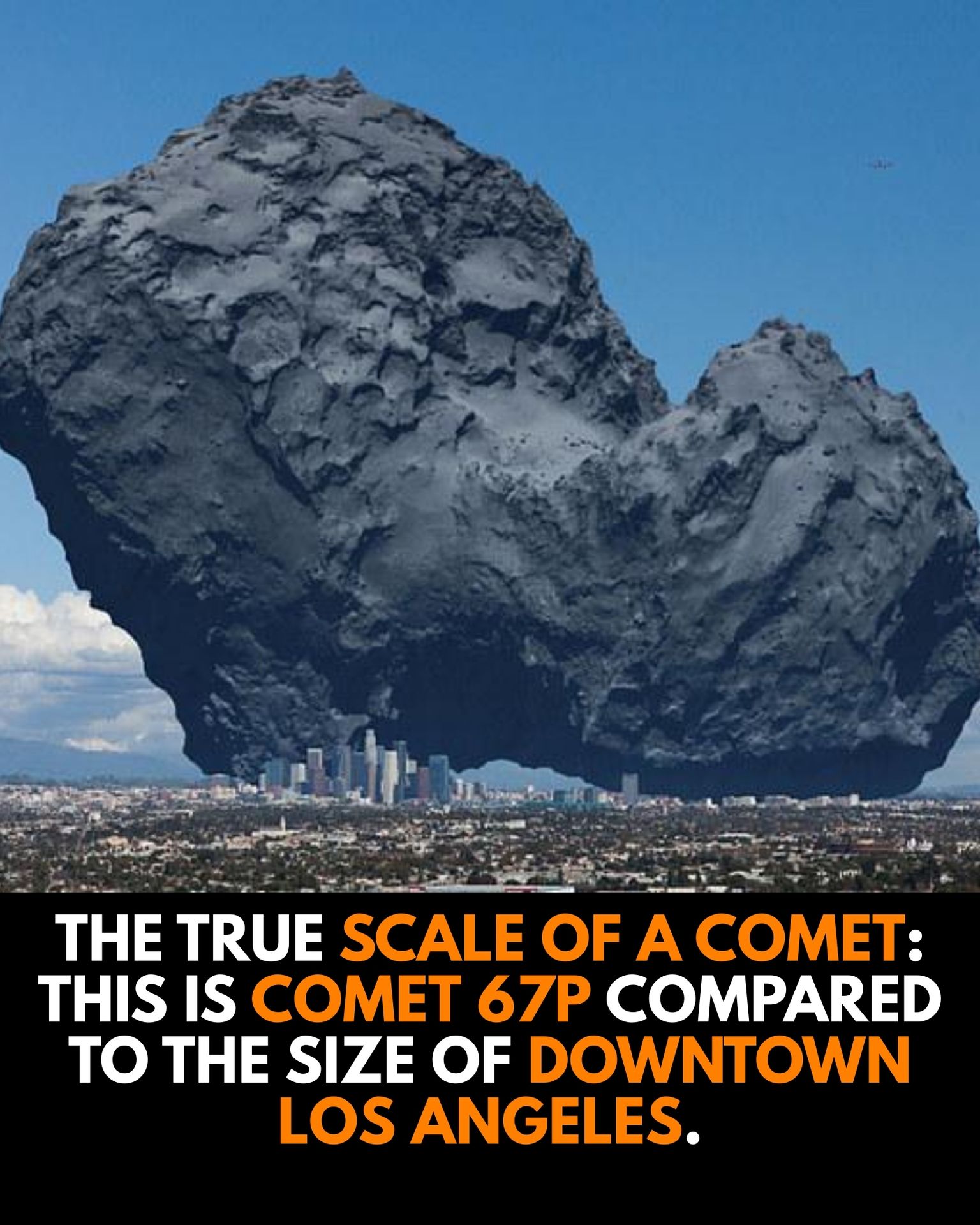
If you were to “park” Comet 67P over a major metropolis like Los Angeles, the comparison would be terrifying. The comet would not just block a few streets; it would loom over the entire downtown district.
-
Vertical Scale: The “head” of the comet rises higher than any skyscraper on Earth.
-
Horizontal Scale: Its length would stretch from the Staples Center past Dodger Stadium, essentially swallowing the urban core.
-
Mass: It is a mountain range flying through a vacuum, composed of ancient ices, carbon-rich dust, and rocky silicate.
[Image comparing the size of Comet 67P to the Burj Khalifa and a city skyline]
The Rosetta Legacy
The 2014 Rosetta mission was a landmark in space exploration because it treated 67P not as a distant light, but as a destination. By orbiting the comet and deploying the Philae lander, scientists were able to “touch” this ancient relic from the birth of our solar system.
They discovered that the comet is surprisingly porous—almost like a sponge—and contains complex organic molecules, the very building blocks of life.
Why Scale Matters
Visualizing 67P over a city like LA serves a dual purpose. It humbles our sense of scale, reminding us that we live in a neighborhood populated by massive, roaming mountains. It also underscores the importance of planetary defense; a “small” speck in a telescope is, in reality, a kinetic powerhouse capable of reshaping a continent.