








Now Reading: The “Tree Army”: How the CCC Rebuilt America’s Spirit and Soil
-
01
The “Tree Army”: How the CCC Rebuilt America’s Spirit and Soil

The “Tree Army”: How the CCC Rebuilt America’s Spirit and Soil
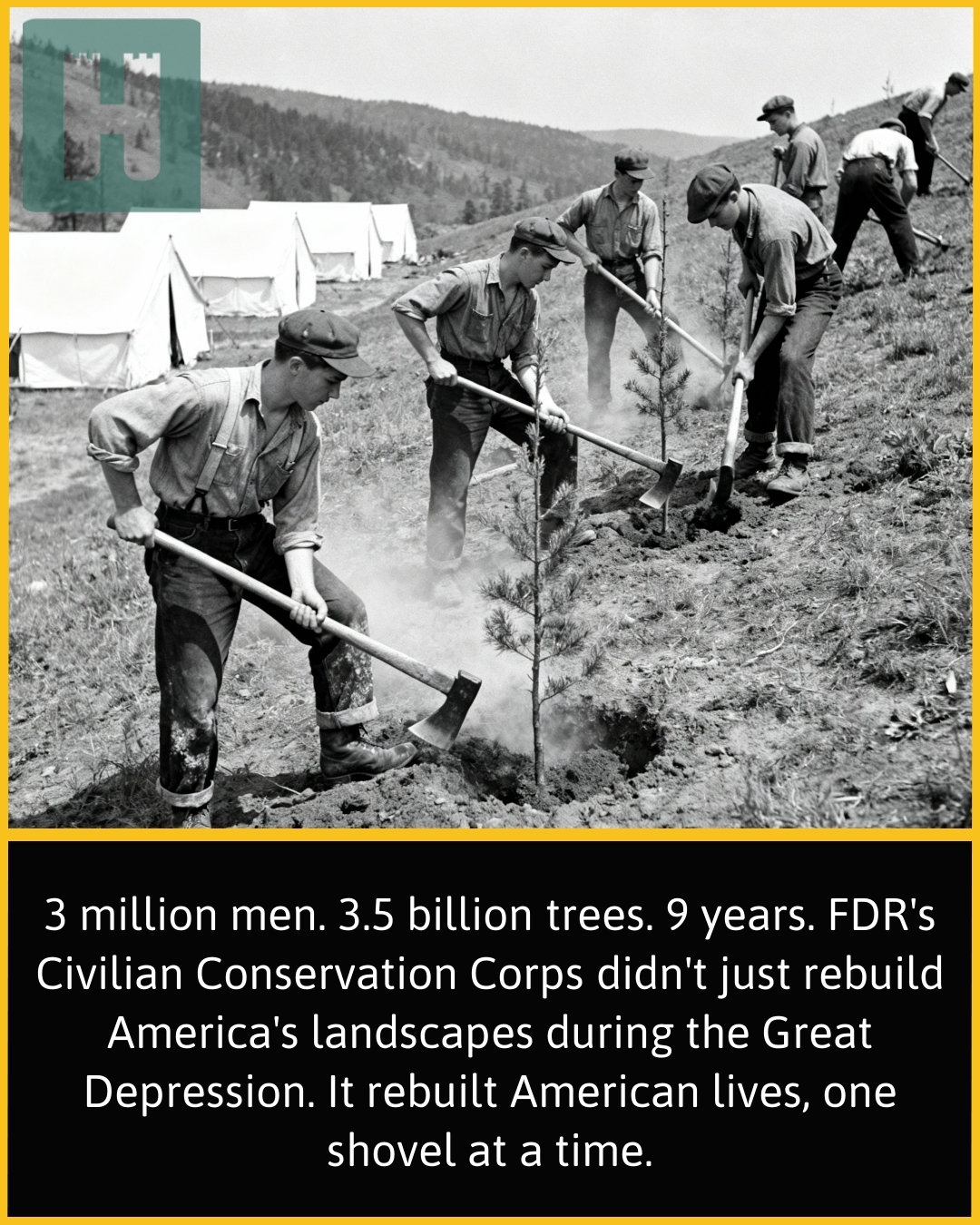
When the Great Depression bottomed out in 1933, the United States faced more than an economic collapse; it faced a crisis of the soul. With millions of young men wandering the streets without work or hope, President Franklin D. Roosevelt launched one of the New Deal’s most ambitious social experiments: the Civilian Conservation Corps (CCC).
Roosevelt’s wager was radical yet simple: rather than just issuing relief checks, the government would hire the unemployed to heal the nation’s ravaged landscapes.
A Legacy in Numbers
Between 1933 and 1942, nearly 3 million young men traded city streets for forest camps. Their physical impact on the American map was staggering, earning them the nickname “Roosevelt’s Tree Army.”
| Accomplishment | Impact |
| Reforestation | Over 3 billion trees planted |
| Infrastructure | 3,470 fire towers and 47,000 bridges built |
| Public Land | Over 700 new state parks created |
| Trail Systems | Thousands of miles of hiking paths carved |
Economically, the CCC was a lifeline for the American family. Enrollees earned $30 a month, but there was a catch: $25 of that paycheck was sent directly home to their parents. For families on the brink of starvation, that monthly check was the difference between a roof overhead and destitution.
The Psychology of Purpose
Beyond the bridges and the biology, the real genius of the CCC was psychological. Roosevelt understood that prolonged idleness breeds despair, and despair breeds social instability. By providing military-style structure, three square meals, and a clear mission, the program restored a sense of self-respect to a generation of men who felt discarded by society.
Participants didn’t just learn how to plant saplings; they learned vocational skills, teamwork, and discipline. Decades later, many veterans of the program would credit the CCC with “saving their lives” by providing a sense of purpose during the country’s darkest hour.
A Living Monument
The next time you hike a terraced trail or seek shade under a hand-hewn stone shelter in a National Park, you are standing in a living museum. Those structures are physical proof that visionary leadership can turn an economic disaster into a generational investment. The seeds planted by the CCC didn’t just grow into forests—they grew into the very foundation of the modern American conservation movement.