












Now Reading: What Would Jesus Think? A Reflection on Faith, Institutions, and the Modern Church
-
01
What Would Jesus Think? A Reflection on Faith, Institutions, and the Modern Church

What Would Jesus Think? A Reflection on Faith, Institutions, and the Modern Church
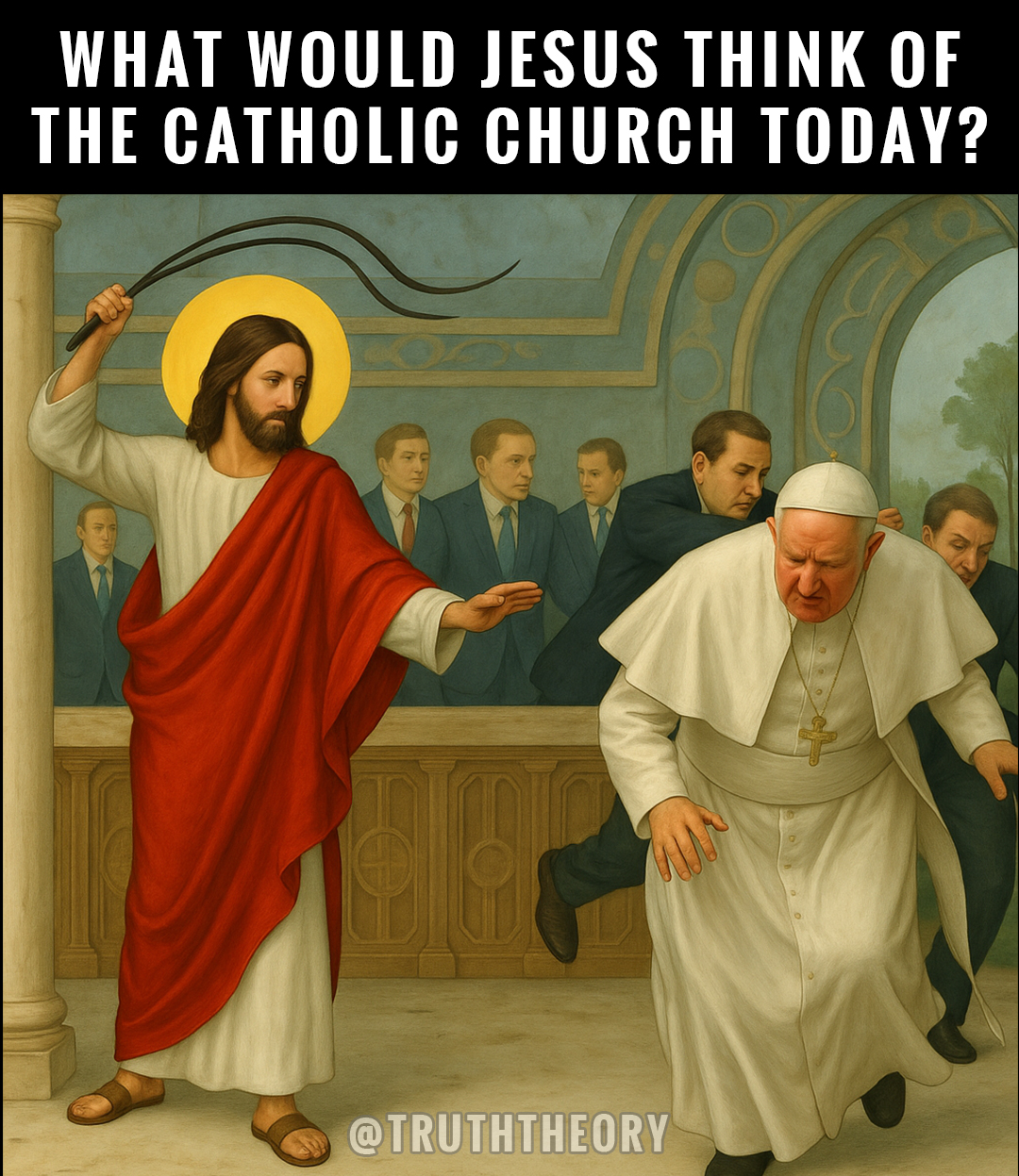
The image above presents a powerful and challenging visual: Jesus, whip in hand, reminiscent of his cleansing of the Temple, with figures resembling modern church leaders retreating in his presence. The accompanying question, “WHAT WOULD JESUS THINK OF THE CATHOLIC CHURCH TODAY?” is a profound one that resonates far beyond any single denomination, inviting all people of faith, or those simply observing, to reflect on the nature of religious institutions and their alignment with foundational teachings.
This depiction, while artistic and interpretive, touches upon a timeless tension: the gap that can emerge between spiritual ideals and institutional realities.
The Temple Cleansing: A Historical Context
To understand the image’s potency, it’s helpful to recall the biblical account it references. In the Gospels, Jesus enters the Temple in Jerusalem and is outraged by the money changers and merchants who have set up shop, turning a place of worship into a marketplace. He overturns tables, drives out animals, and declares, “My house will be called a house of prayer, but you have made it a ‘den of robbers.'” (Matthew 21:13).
This act was not merely about commerce; it was a powerful symbolic protest against the corruption, exploitation, and distortion of what the Temple was meant to represent. It was a call back to purity, justice, and the true spirit of worship.
Applying the Question Today
The image challenges us to ask: If Jesus were to walk among us today, what would he find in our religious institutions, including the Catholic Church, but also Protestant churches, synagogues, mosques, or any organized spiritual body?
- Purity of Purpose: Are our institutions still primarily focused on prayer, spiritual growth, service to the poor, and living out the core tenets of their faith? Or have they, in some ways, become entangled with power, wealth, politics, or bureaucracy to an extent that overshadows their spiritual mission?
- Care for the Vulnerable: Jesus consistently championed the marginalized, the poor, the sick, and the outcast. Do our religious organizations actively and effectively serve these populations, or have they sometimes become insulated, focusing inward rather than outward?
- Humility and Service: The teachings of many faiths emphasize humility, service, and leading by example. Do the leaders and structures of our institutions embody these virtues, or do they sometimes project an image of authority and opulence that feels distant from the humble beginnings of their faiths?
- Authenticity vs. Ritual: While ritual and tradition are important, do they sometimes overshadow genuine spiritual experience and authentic connection with the divine and with fellow humans? Would Jesus, who often challenged rigid interpretations of religious law, find a vibrant spirit of faith or an over-reliance on form?
A Call for Introspection, Not Condemnation
This image is not necessarily an indictment but an invitation for deep introspection. It prompts all of us, whether we are part of an organized religion or not, to consider:
- How well do our personal actions align with the values we profess?
- Are our spiritual communities truly living up to their highest ideals?
- What reforms, big or small, might be needed to bring institutions closer to their sacred foundations?
Ultimately, the question “What would Jesus think?” is a perennial one, designed to keep faith traditions honest, vibrant, and always striving for greater purity, justice, and love in a world that desperately needs all three. It encourages a continuous process of self-examination and a recommitment to the core messages that inspired these faiths in the first place.