













Now Reading: The Art of the Gaze: Deconstructing the “Mecklenburg Eyes”
-
01
The Art of the Gaze: Deconstructing the “Mecklenburg Eyes”

The Art of the Gaze: Deconstructing the “Mecklenburg Eyes”
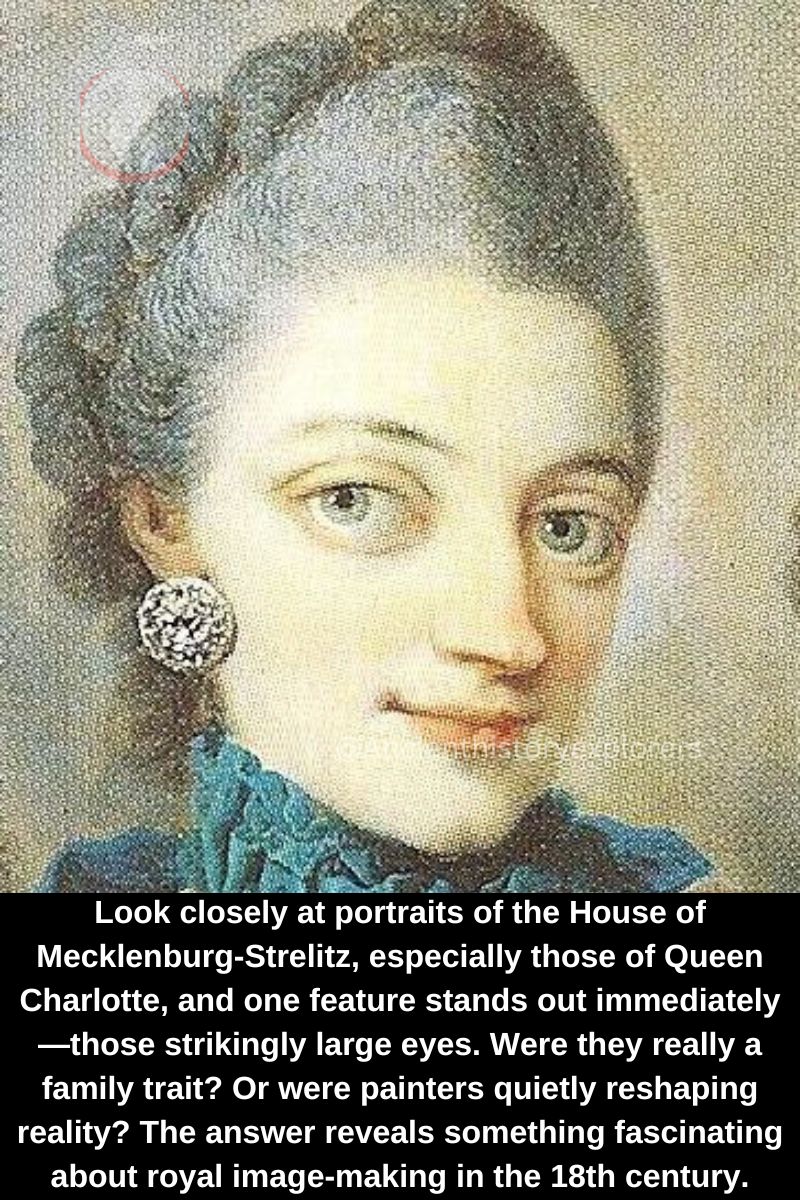
When viewing portraits of Queen Charlotte and her relatives from the House of Mecklenburg-Strelitz, modern observers are often struck by their unusually large, luminous eyes. This prominent feature has sparked historical debates and genetic theories, yet the reality behind these “Mecklenburg eyes” reveals more about the mechanics of 18th-century power than it does about royal DNA.
Portraiture as Public Relations
In the 1700s, a royal portrait was not intended to be a candid snapshot. Instead, it served as a sophisticated tool for public relations. Before the advent of mass media, these paintings were the primary way a monarch communicated their character to the world. Royal subjects needed to appear wise, alert, and soulful—qualities that artists believed were best conveyed through the eyes.
The Painter’s Toolkit
To achieve a commanding presence, court painters like Sir Joshua Reynolds and Thomas Gainsborough employed specific artistic techniques:
-
Idealization: Just as modern filters adjust features, 18th-century artists subtly enlarged the eyes and brightened the whites to suggest intelligence and vitality.
-
Focal Points: By directing lighting toward the upper face and emphasizing the pupils, artists created a “penetrating gaze” that followed the viewer, symbolizing the monarch’s watchful care over their subjects.
-
The “Window to the Soul”: European tradition held that the eyes revealed a person’s inner virtues. An enlarged gaze wasn’t meant to be literal; it was a visual metaphor for a ruler’s moral clarity.
The Role of Mass Production
The exaggeration of these features was often compounded by the way art was distributed. A single “master” portrait would be copied dozens of times by apprentices or local artists to be sent to colonies and government buildings across the British Empire. In the process of manual reproduction, striking features—like the eyes—frequently became more pronounced, drifting further from the original likeness with every iteration.
Historical Contradictions
The most compelling evidence against a genetic anomaly comes from the written record. Detailed journals and letters from Queen Charlotte’s contemporaries often meticulously described her complexion, her fashion, and her poise. Notably absent from these accounts are any mentions of unusually large eyes. If her features had been as dramatic as the paintings suggest, they surely would have been a topic of court gossip.
Ultimately, the famous Mecklenburg gaze serves as a reminder that history is often filtered through the lens of those who recorded it. In the 18th century, a ruler didn’t just need to see; they needed to be seen as a visionary.