












Now Reading: Understanding the Relationship: Breaking Down the Variable $w$
-
01
Understanding the Relationship: Breaking Down the Variable $w$

Understanding the Relationship: Breaking Down the Variable $w$
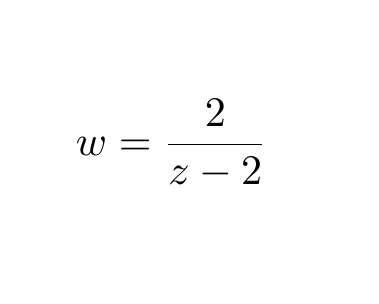
In mathematics, expressing the relationship between two variables is the foundation of calculus and advanced algebra. The equation shown—$w = \frac{2}{z – 2}$—is a classic example of a rational function. This formula tells us exactly how the value of $w$ changes based on what we choose for $z$. For students and math enthusiasts alike, these equations are more than just numbers on a page; they represent real-world curves and slopes that define everything from physics to economic trends.
The Mathematical Breakdown: What Does This Mean?
To understand this equation, we have to look at how the numerator and denominator interact:
-
The Structure: The variable $w$ is the dependent variable, which is determined by the fraction $\frac{2}{z – 2}$.
-
The Critical Point: There is one very important rule for this equation—$z$ cannot be 2. If $z = 2$, the denominator becomes $2 – 2 = 0$, and in mathematics, dividing by zero is undefined.
-
Behavior of the Graph: As $z$ gets closer to 2, the value of $w$ will skyrocket toward infinity or drop toward negative infinity, creating what mathematicians call a vertical asymptote.